
In 2000, Micron landed on a discovery that chopped our average setup time by 47% over the course of a year, without even modifying the machines. It wasn’t a new technology or facility upgrade. It was the realization that our goals are only as good as the processes we use to achieve them.
Where Goals Fall Short
Conventional wisdom says SMART goals — Specific, Measurable, Achievable, Relevant, Time-bound — are the fix. Set the goal properly and change follows. Most people know from experience that this doesn’t always work. And yet, we see examples where heroic goals are achieved even while modest ones fizzle.
James Clear wrote the bestseller Atomic Habits on exactly this gap. He argues that winners and losers have the same goals, so the goal can’t be what separates them.
What separates them, Clear says, is the processes underneath. When the work under the number is sound, the number moves. When it isn’t, no amount of recommitting to the target fixes it. That’s systems thinking, and it’s the part conventional goal-setting advice skips.
Reducing Setup Times
Micron’s need for change started with a shift in the industry climate. We noticed, over time, that our orders began trending toward smaller batch sizes and a broader mix of parts.
More orders meant more setups, and our Acme screw machine setup time averaged 32 hours. Without doing anything worse than we had before, our setup time was swallowing a growing share of every job. We needed better agility.
In 2000, we set a goal: reduce Acme setup time by 25% in six months.
Discovery
We assigned a team of seven employees to work on this goal and blocked out four hours for this project every Thursday afternoon. The team mapped our machinists’ setup paths with spaghetti diagrams, timing each task and tracing every trip across the floor. From there, we developed a color code for the distance traveled from the setup: green for within arm’s reach of the machine, yellow for 10 to 15 feet, and red for everything beyond that.
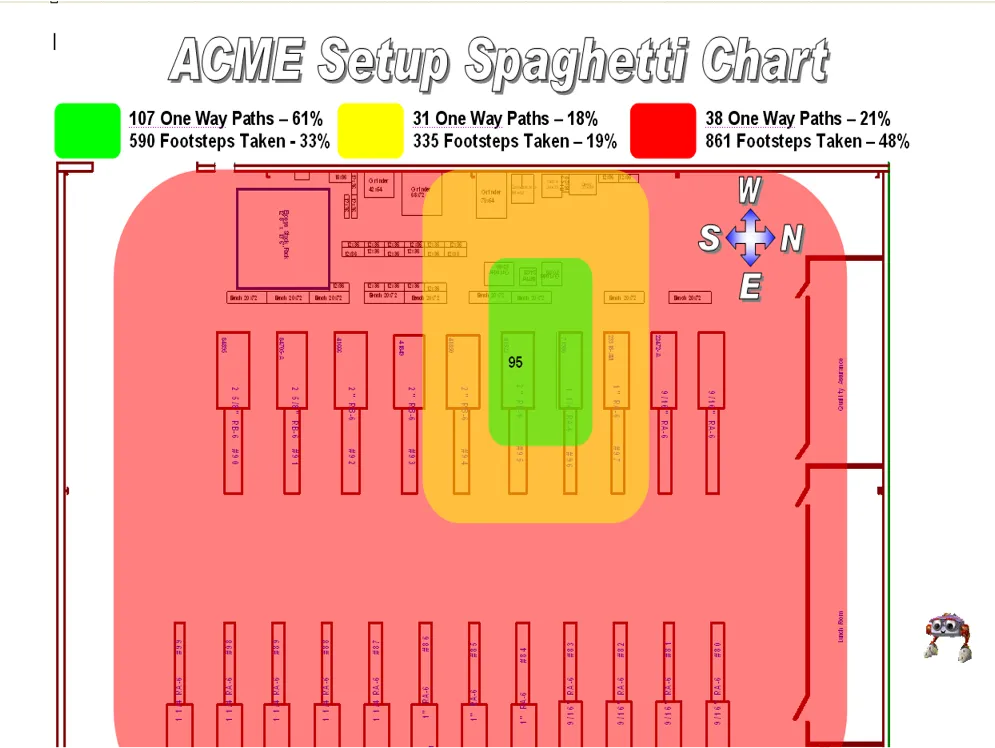
The map surprised us: roughly half of a given setup happened away from the machine, in external tasks like hunting down collets, holders, and pusher pads. The red zone swallowed up 21% of all tasks and 48% of the travel time.
We had spent years working on the machines to make them faster, but the real opportunity was outside of the machines.
Action
Once the analysis had shown us where the problems were, we set to work fixing them. The team applied 5S principles to tooling storage, built cam racks, shadow-outlined setup carts, and wrote a cart checklist so nothing rolled to the machine incomplete. We made sure all setup tools (wrenches, etc.) were available at point-of-use at all times. And finally, we put standard practices into place to make sure that everything was in ready-to-use condition by the time it was needed — tools sharp, tool holders complete with all nuts and bolts, gages pre-set, paperwork on hand.
Results
After six months — the timeframe for our 25% reduction goal — our setup time was down 34%. After a year, setup time was down 47%. After 2 years, 61%. The goal that had once seemed daunting looked modest in hindsight.
This was the moment that solidified a core principle we still operate by today: Improve the systems, improve the outcomes.
Goals are the North Star, Systems Are the Map
Goals still matter. They set the target and keep everyone honest about whether it was hit. But goal-setting advice skips the part that actually gets you there. Our setup team didn’t outperform the goal because the target was well-written. They hit it because they blocked out time, mapped the workflow, and fixed the inefficiencies they identified.
Once we made this connection, the pace of change accelerated. Our work on setup time continued throughout the 2000s, eventually resulting in an average setup time of 3.6 hours by the end of 2007. We also applied the lean lens to sales, estimating, and management, improving processes wherever we found slack. In 2009, we decided to pursue the Shingo Challenge and received the Shingo Silver Medallion for Operational Excellence. A lot has changed since then — CNC turning centers have replaced screw machines and our workforce is largely of a new generation — but our process orientation remains.
Next time your organization sets a goal, take it one step further and outline the process that gets you there.
Recent Comments